
Hot Products
- Request A Quote
How to Choose a Sunlight-Readable TFT Display for Outdoor Equipment
Publish time:2026-10-15 10:34:53
Detailed Product Description
An LCD that looks clear indoors may become difficult to read outdoors. Strong ambient light, reflections, viewing angles and temperature can all affect the user experience.
When selecting a sunlight-readable TFT display, do not evaluate brightness alone. Consider the complete display assembly and the actual installation environment.
1. Start with the Ambient Light Conditions
Determine where the product will be used:
Indoors under controlled lighting.
Outdoors in shaded locations.
Outdoors under strong daylight.
In direct sunlight, where reflections and high ambient light may significantly reduce readability.
These scenarios have different requirements. Define the expected viewing conditions before specifying brightness.
2. Check Display Brightness
Brightness is usually specified in candelas per square metre (cd/m²), also called nits.
Higher brightness can improve visibility in bright environments, but it may increase backlight power consumption and thermal load. The appropriate level depends on the product, ambient light and optical design.
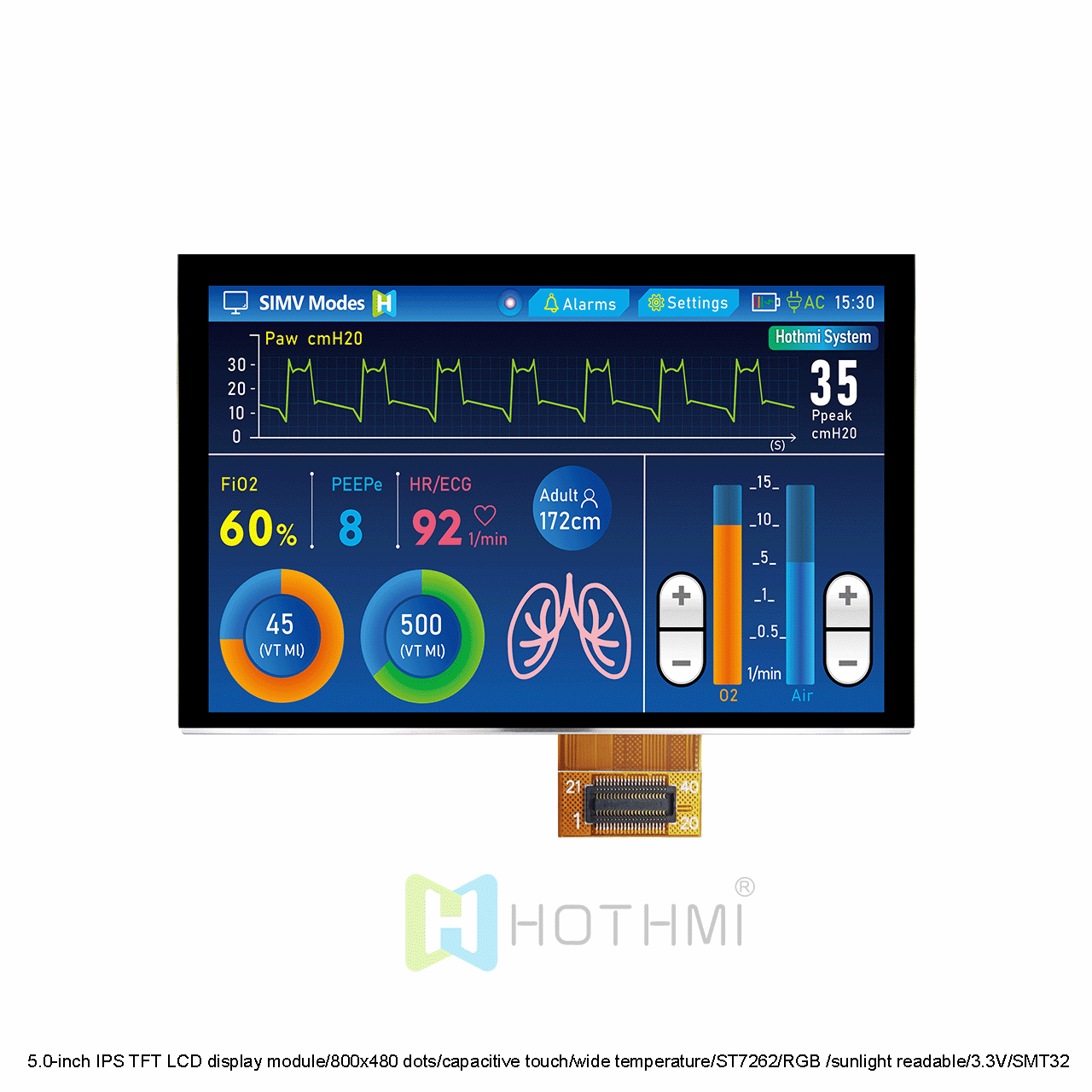
HOTDISPLAY's catalogue includes specific high-brightness products. For example, one listed 5-inch IPS TFT LCD model specifies 1700 cd/m². This is a model-specific value, not a specification shared by every HOTDISPLAY display.
Confirm the required brightness, power consumption and thermal conditions in the exact model's datasheet.
3. Consider IPS and Viewing Angle
IPS technology is worth evaluating when users need to view the screen from different directions.
However, IPS alone does not guarantee sunlight readability. A display can have a wide viewing angle and still be difficult to read under direct sunlight if its brightness and optical design are unsuitable.
Compare viewing angle, contrast, brightness and intended mounting orientation together.
4. Reduce Reflections from the Front Surface
Reflections can make display content difficult to see, even when the backlight is bright.
Depending on the product, cover-glass surface treatments may include:
AG (anti-glare): Helps diffuse reflected light.
AR (anti-reflection): Reduces surface reflections.
AF (anti-fingerprint): Helps reduce visible fingerprint marks and ease cleaning.
These treatments serve different purposes. Select them based on lighting, appearance, cleaning and touch requirements rather than assuming one coating solves every visibility problem.
5. Evaluate Optical Bonding Where Appropriate
Air gaps between optical layers can introduce reflections. Optical bonding may help reduce internal reflections and improve the integration of the display and front glass.
Whether bonding is available or beneficial depends on the product construction and project conditions. Confirm the proposed assembly and environmental requirements with the supplier.
6. Check the Operating Temperature
Outdoor equipment may experience cold starts, high enclosure temperatures and rapid environmental changes.
Check the display's specified operating and storage temperature ranges. Do not confuse operating temperature with storage temperature, and do not assume that every high-brightness or IPS model supports the same range.
Also consider heat generated by the backlight and the thermal conditions inside the final enclosure.
7. Outdoor TFT Display Selection Checklist
Before choosing a model, confirm:
Required brightness under real ambient-light conditions.
IPS or other viewing-angle requirements.
Cover-glass reflection and surface-treatment needs.
Whether optical bonding is appropriate and available.
Operating and storage temperature.
Display interface, resolution and power requirements.
Mechanical dimensions and mounting conditions.
For demanding applications, evaluate the display in a representative enclosure under realistic lighting and temperature conditions.
Frequently Asked Questions
Is a 1000-nit display always sunlight-readable?
Not necessarily. Readability also depends on reflections, contrast, cover glass, viewing angle and ambient lighting. Test the complete assembly in the intended environment.
Is IPS required for outdoor displays?
No. IPS may be useful for viewing-angle performance, but the selection depends on the complete optical and electrical requirements.
Can HOTDISPLAY supply high-brightness TFT LCD displays?
The catalogue includes selected high-brightness models. Confirm the exact brightness, temperature range, interface and dimensions from the relevant product page and datasheet.
Should I choose AG or AR glass?
AG diffuses reflected light, while AR is intended to reduce reflections. The best choice depends on the front-surface design and viewing environment.
Request an Outdoor Display Recommendation
Share the required brightness, operating temperature, display size, interface and installation conditions with HOTDISPLAY to identify relevant models and discuss available cover-glass options. Explore all sunlight readable LCD at Hotdisplay
Hot Articles
Address: No. 22, Xinlesi Rd., Ma 'an Town, HuiCheng District, HuiZhou, 516057, Guangdong, China
- Tel:+86 18929368919
- Email: sales@hothmi.com
- Worktime:9:00-18:30
- Contact Person:Mrs. Dong
- Mobile Site